Hot ImagesHot ImagesHot ImagesHot ImagesHot Images
Showing posts with label Olympics. Show all posts

September 10, 2012

The camera-friendly bloody-mindedness of Yohansson Nascimento

Having been away from London for the whole summer, I feel a little disconnected from the all-pervading jubilation that seems to have seized the city. Not that I didn’t love the opening ceremony and punch the air over Mo Farah’s triumphs and I’ve even grinned a wee bit at the non-Olympic excitement that will inevitably get folded into the cake mix of memory, such as Andy Murray’s nailbiter a few hours ago. (I bet when Bradley Wiggins won the Tour de France, he thought “Well, that’s the BBC Sports Personality of the Year wrapped up.” Now he may not even get a nomination.)


And I did notice this vignette from the Paralympics, in which the Brazilian sprinter Yohansson Nascimento pulled up injured but insisted on crossing the line. Of course, Lu Xiang did much the same thing a few weeks before in the 110m hurdles; and older readers will recall Derek Redmond being helped towards the finish by his dad in 1992, a clip that always makes me well up.

Now, I’m not a professional athlete, so I’ve no idea what it feels like to have all your dreams dashed in a split-second, all that training gone to dust, your body turning round and biting you on your/its own arse. What are they setting out to prove by staggering, stumbling, falling over the line? We know that they can cover the distance. And we know that they’re injured, so we understand why they haven’t won. In the depths of their misery and agony, maybe they think, “At least if I finish I’ll make it onto the feelgood clips at the end of the tournament, when they play the Chariots of Fire music.”

And it’s only in race events, isn’t it? After Murray won the US Open, I bet Djokovic didn’t knock a few more balls over the net, just to prove he could.

PS: You are reading my Infinite Jest blog, aren’t you? It’s jolly good, you know. And not as long as the book. Yet.

August 10, 2012

I vow to thee my pasty


Well, the Olympics has got all some of us feeling terribly British and flaggity-wavery all of a sudden, but one or two people apparently want to widdle on the flame. I’m not just talking about Alex Salmond and his Scolympians (which sounds to me like a species of alien mollusc), but also the head of the tourist body Visit Cornwall, who wants to avoid references to England in any promotional material for the county. Sorry, make that duchy – the word “county” is also verboten. Cornwall is just Cornwall, and that’s where people should go. The fact that they’ll have to go through Devon to get there is but a minor inconvenience.

This does help to remind us that the entity we define as the United Kingdom is a fairly recent invention, and in a political sense only really goes back to 1707, with the Act of Union between England and Scotland. Since then, Ireland has joined the party and then (mostly) left it again, so the current map of the United Kingdom is less than 100 years old; when UKIP’s tosspot-in-chief Nigel Farage dismissed Belgium as “an artificial construction” I wondered why he thinks that couldn’t be applied to the entity he so zealously seeks to release from the bonds of Euroserfdom. Even if we cleave to the notion that England – as distinct from the UK – is a valid concept, we have to accept that for plenty of people a regional or civic loyalty trumps any fealty to nation or country. This is true in Cornwall, Liverpool and also Yorkshire, where they’ve been calculating how many medals they’d have taken if the county had entered the Olympics as a separate entity. I now find that when I’m outside the UK and someone asks where I come from, my immediate response is usually “London”.

I’d guess that every country – barring a few small, relatively homogeneous island or city states – has areas that attract this sort of local loyalty, whether or not they’re actively yearning for independence. National citizenship is simply an administrative necessity, rather than an expression of an emotional bond. I’ve been to New York and Barcelona, for example, but I know damn well that doesn’t mean that I’ve been to the USA or Spain. Are there any real Italians, or are they at heart Venetians and Sicilians and so on? Home is not necessarily where your passport says it is.

August 4, 2012

#London2012: regarding the keirin

 
I’ve just realised that in the midst of the most spectacular sporting event to grace my native land since they cancelled We Are The Champions, I’ve written three blog posts about the opening ceremony and precisely none about the actually running and jumping and throwing and all that malarkey. You see, when healthy lads of my age were glued to Grandstand and World of Sport, or out in the park trying to emulate Kevin Keegan or Brendan Foster, I’d be stuck in my bedroom using the continuous paper my dad brought back from work to recreate in prose form the dystopic sci-fi that dominated my imagination and TV viewing.

So while I have the deepest respect and admiration for plucky Victoria Pendleton and her success in the keirin yesterday, I have to admit that to me, this is not so much a sport, more a combination of 


and

and

July 30, 2012

Still not sure about the big baby: a few more thoughts about the Olympic ceremony and that

Some stuff that should probably gone into the previous post.

1. Previous opening ceremonies either dutifully toed a political line (Berlin 1936, Moscow 1980, Beijing 2008) or expressed a prevailing zeigeist (Los Angeles 1984, Sydney 2000) that happened to tie in quite neatly with what the government wanted saying anyway. If Boyle’s efforts were truly subversive, was he just expressing a general mood that stands in opposition to what Cameron et al want Britain to be? Ai Weiwei liked it, which makes one wonder how many flavours of excrement would have hit the fan had he been in charge four years ago.

2. That said, I’m still slightly confused about the whole Industrial Revolution thing. Some right-wingers, claiming the whole thing was a leftie plot, have suggested that the event presented Brunel and co as evil, rapacious capitalists intent on tarmacking over Merrie Englande, whereas Boyle’s collaborator Frank Cottrell Boyce says that the huge technological upheaval was one of the “things we loved about Britain” and wanted to celebrate. I suppose it does expose the incoherence of English conservatism, yearning for an idealised, quasi-pastoral past while lauding the entrepreneurial spirit that wiped it out.

3. That Daily Mail article. Oh dear.

4. For some reason I keep thinking back to that poor man who died at Tate Modern last week and the rumour that some people initially thought it was a piece of performance art. If something hideous had happened during the ceremony, how soon would it have been before someone twigged? And would it be appropriate to quote Bill Shankly?

5. Not directly related to the ceremony, but anyway: the empty seats fiasco; and the problems in TV coverage of the cycling being blamed on excessive Twitter use. Do people still need to attend sports events in person? Do they still even need to see them on TV? I didn’t watch the opening ceremony live, but I followed it on Twitter. In 20 years’ time, will athletes be fencing and diving and underclad-volleyballing in near-empty stadia, accompanied only by the tap-tap-tap of a few accredited live tweeters?

6. David Hockney’s response to the whole thing:


July 28, 2012

The Olympic opening ceremony: being Boyled

(The following thoughts are pretty much a synthesis of about 14 different conversations I’ve been having on various online media over the past few hours. As such, they are probably neither original nor coherent. You have been warned.)


I was a bit torn a few weeks ago when the news came that the test for prospective UK citizens will contain more questions about history. On the one hand, this is something I can only applaud, because it’s impossible to understand what makes a country or culture tick without knowing how it came to be where it is. But when you get to the nitty-gritty of which bits of history should be included, things become more complex. Nelson and Wellington and Churchill, fair enough; but what about the Putney Debates, the Rebecca Riots and the Tolpuddle Martyrs? The Jarrow Crusade and the Battle of Cable Street? Too political you say? But Churchill wasn’t?

You see, even if you agree on the basic facts, there are always multiple histories, parallel, interweaving, depending on the emphasis you choose to place on those facts. And in that spirit I bloody loved Danny Boyle’s opening ceremony for the Olympic Games. His was a people’s history of the UK, Blake rather than Kipling, suffragettes rather than Beefeaters, Dizzee Rascal, not the Last Night of the bloody Proms. And the CND badge and the Brookside lesbians and, of course, the glorious in-your-face-Cameron salute to the NHS. Anything that provokes Telegraph readers into splenetic online rants about the evils of multiculturalism has to be good value.

But hang on a moment. Was it really as cheeky and subversive as it seemed? Boyle wanted to make a story about revolutions but rather than Hegelian dialectic we got phallic chimneys appearing from the ersatz countryside as the industrial revolution brought pollution and capitalism to the countryside, turning everything dark and satanic. And yet Brunel and his top-hatted, bewhiskered chums were still presented as the good guys, forging the modern age and beginning a continuum that leads inexorably to a benign Tim Berners-Lee at his desk. Take that, greens and lefties alike. And there was still Elgar and there was still James Bond, purveyor of thick ears to assorted dangerous foreign types. And yes, there was still the Queen, even if she didn’t appear to be enjoying it as much as she’d revelled in that strange boaty jamboree last month.

Baudrillard would have argued that we’re simply blinded by the razzmatazz and spectacle of the whole thing, that obscures and eventually supplants the reality, including historical reality. And sure, there were lots of fireworks. But there’s also a sense that the very real spirit of subversion and nonconformism and sheer bloody-mindedness in British history has been appropriated; what Debord and the Situationists called recuperation. Yes, there were bits of the Stones and Bowie and the Sex Pistols and Frankie Goes To Hollywood, music that shocked and disturbed when it came out. But punk rockers became a posse of outsized marionettes, far more funny than scary. It all came through the door marked HERITAGE.


This is the problem when a nation decides to build its post-imperial identity around irony and self-deprecation, where the worst sin is to take oneself too seriously. To be truly subversive, to truly shock, Boyle would have had to come up with something utterly po-faced and self-important. A bit like the Beijing gig four years ago, in fact.

Maybe that at least would have made the Queen crack a smile.

July 26, 2012

#savethesurprise: a sneak preview of the bloody Olympic ceremony


Well, the Olympics have already started, with comedy flag mishaps and racist tweets aplenty, but at the same time they haven’t started, because the opening ceremony hasn’t happened yet. Apparently Schrödinger’s Cat has managed to sponsor the bloody thing without anyone noticing.

Actually, ignore that. Danny Boyle’s opening ceremony has happened, but it was only a trial run and everyone who was present has been put on spoiler alert, encouraged to keep schtumm by the slightly emetic Twitter hashtag #savethesurprise. One wonders why there was all that trouble about G4S security guards not turning up; the terrorist threat could be neutralised at a stroke with a hashtag along the lines of #pleasedontblowusup.

Well, this isn’t Twitter. Apparently, what Boyle has done is to remake his first and best film, Shallow Grave, with Sebastian Coe, Boris Johnson and Jeremy Hunt finding that their new flatmate George Osborne has died of acute self-awareness, stealing his suitcase full of cash and using it to rebuild a replica of the Millennium Dome which turns out in fact to be a Ron Mueck sculpture of the Duke of Edinburgh’s inflamed bladder, stuffed with sheep and WAGs and Morris dancers, all of whom perish horribly to the strains of the theme song from It Ain’t Half Hot Mum. As the only-slightly-racist Land of Hope and Glory bit fades away, all that’s left amidst the carnage is Princess Beatrice, dressed in nothing but that bloody hat and a single fake Burberry sock, attempting to recite the words “They think it’s all over... it is now!” but failing, again and again, forever.


PS: At least Oddbins gets the joke.

May 1, 2012

Duran Duran and the Olympic gig: white boys always shine

I’ve never been a big fan of positive discrimination, mainly because it doesn’t work; inevitably it’s easier to base quotas on empirical criteria such as race or gender or disability, rather than things that are harder to quantify but no less real, such as socio-economic status class, there, I said it. But I couldn’t help but raise an eyebrow at the choice of acts for the gig marking the beginning of the Olympics. Leave aside for the moment the galumphing tedium of all the performers on the bill; Duran Duran were moderately amusing for a couple of albums in the early 80s, while the others (Paolo Nutini, the Stereophonics, Snow Patrol) have never even aspired to such lofty standards. That said, do we really think that London in 2012 is best represented by a dozen or so white men in their 30s, 40s and 50s, many of them playing guitars?

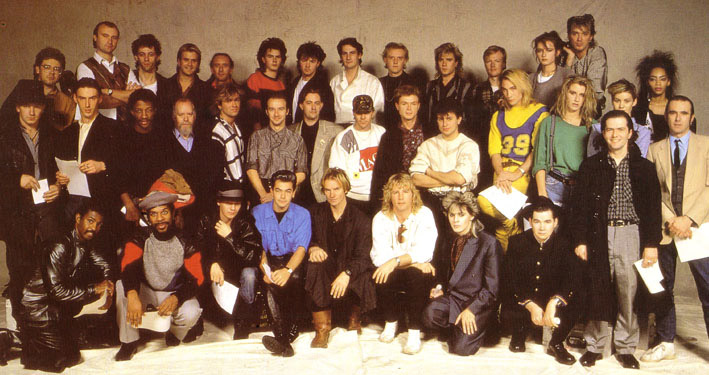
Obviously nobody wants blatant tokenism: I’m old enough to remember the line-up for the Band Aid single, with a few members of Shalamar and Kool & the Gang hovering around the edges. But for an event that aims to show off 21st-century Britain to the world, this is a bit embarrassing.

PS: In the Telegraph, Lucy Jones fumes.