Hot ImagesHot ImagesHot ImagesHot ImagesHot Images
Showing posts with label art. Show all posts

November 8, 2012

On Stuckism


Charles Thomson (I’m assuming it’s really him, but since I’ve been following the US election on Twitter my ability to distinguish trolls and sock puppets and non-specific pranksters from the real deal has completely evaporated) has responded to a passing mention I made of him in a post about Damien Hirst’s new piece in Ilfracombe:
I not only existed, but was exhibiting art, performing poetry and staging events, when Damien Hirst was still at primary school. I can assure you that I was not in the slightest annoyed by Hirst at this time, as I had never heard of him. 
...to which I responded that yes, I accept all that, but my reference was specifically to Stuckism, the movement for which he’s become the de facto spokesman and as far as I know that didn’t come into existence until the late 1990s, by which Hirst and his chums were pretty well embedded in the public consciousness. No YBAs/BritArt/New Conceptualism, no Stuckism. This doesn’t reflect on Thomson’s own talents as an artist; I rather like his fusions of Pop Art and Expressionism to be honest, certainly more than I care for most of Hirst’s vapid gestures. But the fact remains that when Thomson appears in mainstream media, it’s more likely to be as part of a story about Hirst’s art than Thomson’s. Stuckists have become defined by what they’re not rather than what they are or what they do; in effect, they’re critics rather than artists, the provisional wing of Jackdaw magazine. I’m not saying this is an ideal state of affairs, or fair, or a good thing in terms of art, but that’s how it is. In hindsight, art historians may well come to agree that the Saatchi/Serota generation was an enormous, bloated con trick and Thomson and his gang were right all along but – notwithstanding the recent critical kicking that Hirst’s had in some quarters – the not-so-Young-any-more British Artists are still on top right now.

Put it this way, Charles: most Express readers probably loathe Damien Hirst and his works and everything he and they stand for; until they’d read the article I was discussing, most Express readers had no opinion about you or your work, because they’d never heard of you. We’re in Oscar Wilde territory here; which would you prefer to be?

November 6, 2012

Bodypainting: what’s it all about? (NSFW)


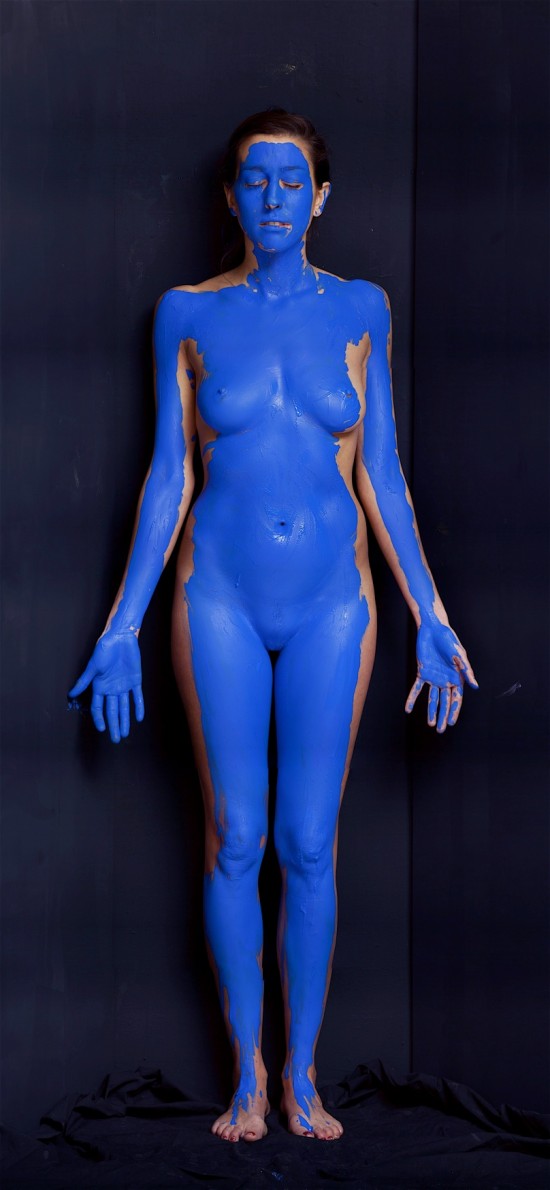
Is bodypainting art? Or is it mere craft, with a bit of titillation thrown in, sometimes on the verge of soft porn? Danny Setiawan, I suppose, thinks it’s art. His stuff is available through Saatchi, although I’m not sure whether when you buy one of his works, you also buy the person on whom the art is painted. Where does the art stop and the canvas start? More to the point, when Setiawan paints a Klimt on a model’s chest, is it more or less art than if he’d used an original design? Maybe we could argue that Klimt is art; copying Klimt is craft; copying Klimt onto boobs is porn? Or is that unfair? Would painting a Rubens nude (art) on a real nude (porn) confuse the issue further?

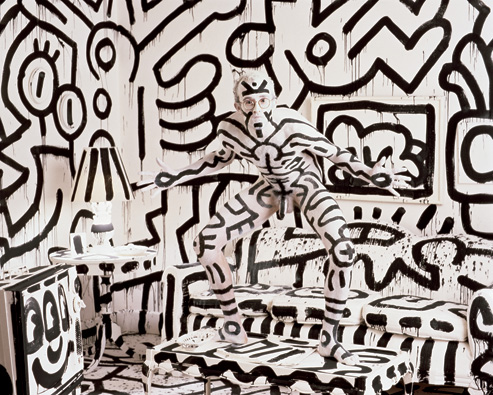
We can have even more fun with Olaf Breuning. He’s also inspired by other artists when he paints on naked people, but his stuff is less about copying an existing, well known painting, more about identifying a theme. But some of the artists he chooses were known for their own paint/skin interfaces, such as Keith Haring:


and Yves Klein:


In fact, one could argue that Klein’s art was in fact the marks left behind by his blue-painted models, rather than the models themselves; so what Breuning is creating is a simulacrum not of Klein’s art, nor even his canvas, but of his paintbrushes. In fact, since his pieces depend entirely on our knowledge of the original works and our response to them (if we like or dislike Haring or Klein, does that make us like or dislike Breuning’s takes on them more or less?) then what he is doing isn’t so much art or craft or porn – it’s more like criticism. With boobs.

October 17, 2012

Damien Hirst vs the (Art) World

 
Well, maybe one shouldn’t expect cutting-edge coverage of contemporary art from the Express, but I reckon they’d be pretty good at picking up the vibe in Ilfracombe. The blameless Devon townlet is the location for Damien Hirst’s latest project, a 66-foot brass figure called Verity, and one Karen Farrington went to find out what they think of it. Opinion is mixed, as it usually is when it comes to big new statues. Paul the hotel porter can’t stand it and neither can Julie the Lib Dem councillor. But Peter from the yacht club and Dawn who owns the pub both think it’s fab. Caroline who runs the chippy doesn’t like it much herself, but thinks it’s a good thing if it attracts tourists.

But Karen’s not satisfied with that, oh no. She also wants to find out what yer actual experts think. And do you know what? They bloody well hate it and they bloody well hate Damien. But hold your bifurcated cows for a moment; which experts did she ask? Well, Julian Spalding, whose anguished Jeremiad about conceptualism I discussed a few months ago; his quote about Hirst being akin to the Mafia provides the article’s headline. And David Lee, who publishes The Jackdaw, the main purpose of which is to lay into conceptualists and their hangers-on. And of course Charles Thomson of The Stuckists, who simply wouldn’t exist if Damien and his like weren’t around to annoy them. The most staunch defenders of the YBAs, the likes of Jopling and Serota, Collings and Saatchi, don’t get a look in. So if you only had to the article to go on, you’d get the impression that Hirst has no support whatsoever in the poncey, up-its-own arse modern art world, whereas a lot of the good folk of Ilfracombe are prepared to give him the benefit of the doubt. Rather than being a sinister conceptualist Mafioso, Hirst comes across as an honest craftsman, cast out of fashionable London society but finding respect with the decent Express-readers of the provinces; he’s like LS Lowry, maybe, or Beryl Cook.

I’m not entirely sure that’s the impression the article was meant to convey. In fact, the piece is so out of sync with its headline, maybe it should be considered as an arch piece of conceptual art in its own right. Karen Farrington for the Turner, I reckon.

October 8, 2012

Rothko vs the Yellowistzzz


OK, I’m officially bored with people defacing works of art in the name of art (or anti-art or something along those lines). The joke’s just become too ingrown. Yeah, yeah, Vladimir Umanets, you got your name – and that of your precious Yellowism – in the papers. But you also knew that deep down that for most people your stunt would simply provide yet another excuse to trot out all those tiresome “a-child-of-five-could-do-that” whines about modern art; which LC, incidentally, has curated into a rather fetching conversation piece in its own right. Maybe he should ask Mr Umanets to scrawl all over his blog.

And in any case, there’s nothing new about it. I ran through the most notable examples of recent years a while ago; but some restoration work on frescoes in Valencia Cathedral has uncovered an even older example. Apparently a 17th-century workman had scratched a full set of gentlemen’s trouser equipment into an angel’s wing. Unfortunately he isn’t around to expand on his aesthetic justification.

October 3, 2012

Hanbury Street: who nose?


Not entirely sure what to make of this. An LA graffiti artist, Mear One, has painted a mural in Hanbury Street, east London, which, according to how you choose to interpret it is either an attack on global capitalism or a collision of several different bonkers conspiracy theory tropes with a distinct stench of anti-semitism. “Oh, but those big-nosed guys on the Monopoly board aren’t meant to be Jewish,” say the picture’s defenders. “They’re just, y'know, capitalists. With big noses.” The fact that the mural appeared in a predominantly Muslim area has escaped nobody’s attention.

Without wanting to descend to a pointless game of whataboutery, maybe those Danish cartoons were just pictures of some bloke. With a turban. Oh, and while we’re there, check out Amazon’s Dachau jigsaw; and, from a free speech perspective, William Saletan at Salon. My view? None of these things should be banned; but that doesn’t necessarily mean that it’s sensible to do them either.

Meanwhile, on a cheerier note: over here, I write an entire blog post about one footnote.

PS: Panic over. The mural’s going. But not before it becomes the victim of another moment of impromptu street art.

September 22, 2012

Frescogate: Cecilia Giménez goes a bit Damien Hirst


More intrigue from the Santuaria de Misericordia in Borja, as that nice old lady who turned the image of Jesus into a sad-eyed monkeybeastling has announced that she wants a slice of the tourist revenue. If we are going to have such a socio-aesthetic construct as outsider art, creativity that benefits from its amateur, outlying, renegade status, does it cease to be worthwhile the moment the artist tries to cash in on it?

August 29, 2012

Professor Stephen Graham: “very silly” (allegedly)


Context determines much about how we perceive art; graffiti is an eyesore until it’s determined to be by Banksy or John Lydon, at which point it goes into a gallery or becomes appropriate raw material for academics to ponder. And that 120-year-old Ecce Homo fresco in a church in Zaragoza is rather more famous now it’s been, um, restored by a parishioner and, I guess, a bit more valuable as well.

So I was immediately sceptical when nice residents of a nice street in a nicer bit of Newcastle claimed to be discombobulated that their nice cars had been vandalised with words such as “VERY SILLY” and “ARBITRARY”, spelled correctly and all. The Daily Mail in its wisdom has decided that the culprit is one Stephen Graham, a professor at Newcastle University where he focuses on cities, technology and surveillance; here he is on the subject of London’s Olympic lockdown. I should stress that Graham has been arrested and charged, but not convicted of any offence, so someone at the Mail should really get a major bollocking some time this morning; but still, I’d guess that having one’s Merc or BMW etched with what may be the initial notes for a groundbreaking thesis on ostentatious consumption by the bourgeoisie of North-East England would double its resale value at least. If I were a well-off car-owner in Jesmond, I’d be slipping Professor Graham a research grant to enable him to scratch a bit deeper.

August 27, 2012

The deep superficiality of Andy Warhol


So if you’re running an exhibition featuring 260 works by one of the most famous, collectible artists of the past 100 years, you’d make a big song and dance about it, right? Right? Well, apparently not if you’re the ArtScience Museum in Singapore, where Andy Warhol: 15 Minutes Eternal appears to be doing rather less well than Harry Potter: The Exhibition. They didn’t even want to us to pay for our tickets; we just needed to photograph ourselves amidst the soup cans and soap boxes strewn around the foyer – simulacra of simulacra, extra postmodern points there guys – and we were waved in.

In many ways it’s an impressive show; the pieces range from very early sketches to his photos of the ugly/beautiful denizens of New York’s mid-80s club scene. As with several other artists often dismissed as charlatans – Pollock, Klein, Emin – you need to get up close to the real works to discern that Warhol could actually draw and paint.

But hey, this is the 21st century and interactivity is the watchword, so the punters demand more than just a bunch of pictures in a bunch of rooms. You can don a ratty wig and be Andy for a while, toss around big, metallic balloons, watch audition films for wannabe superstars and rehearsal footage of the Velvet Underground. But this is a slightly sanitised version of Warhol: his nickname, Drella, was a synthesis of Dracula and Cinderella, which would suggest that he wasn’t exactly what you might call a nice guy. His sexuality, his voyeuristic tendencies, his fondness for ethically questionable clients such as Imelda Marcos are all glossed over. I didn’t even notice an acknowledgement that he was bald. There’s a nice mock-up of the Factory itself, because we all wish we’d hung out there, don’t we? In your own 15 minutes are you Lou or are you Edie? But what it really needs is for someone dressed as Valerie Solanas to burst in, wielding a .32, come to hunt down her own personal Voldemort.

I bet they’re already planning 50 Shades of Grey: The Exhibition. But with all the sex taken out.

August 6, 2012

Plop art

The Oriel of the Blue Horses, an installation by Martin Gostner, has gone on display at the Neue Nationalgalerie in Berlin. It’s horse shit. No, make that fake horse shit. Now, I’m always ready to defend the wild-eyed imaginings of the conceptual art posse against the sneers of Call-That-Art?-A-Child-Of-Three-Could-Do-That, Inc, but it does look as if this time Gostner has just stapled a sign saying “KICK ME” to his own arse. Or maybe that’s his next piece.

I wonder what the late Robert Hughes would have made of it all.

July 30, 2012

Still not sure about the big baby: a few more thoughts about the Olympic ceremony and that

Some stuff that should probably gone into the previous post.

1. Previous opening ceremonies either dutifully toed a political line (Berlin 1936, Moscow 1980, Beijing 2008) or expressed a prevailing zeigeist (Los Angeles 1984, Sydney 2000) that happened to tie in quite neatly with what the government wanted saying anyway. If Boyle’s efforts were truly subversive, was he just expressing a general mood that stands in opposition to what Cameron et al want Britain to be? Ai Weiwei liked it, which makes one wonder how many flavours of excrement would have hit the fan had he been in charge four years ago.

2. That said, I’m still slightly confused about the whole Industrial Revolution thing. Some right-wingers, claiming the whole thing was a leftie plot, have suggested that the event presented Brunel and co as evil, rapacious capitalists intent on tarmacking over Merrie Englande, whereas Boyle’s collaborator Frank Cottrell Boyce says that the huge technological upheaval was one of the “things we loved about Britain” and wanted to celebrate. I suppose it does expose the incoherence of English conservatism, yearning for an idealised, quasi-pastoral past while lauding the entrepreneurial spirit that wiped it out.

3. That Daily Mail article. Oh dear.

4. For some reason I keep thinking back to that poor man who died at Tate Modern last week and the rumour that some people initially thought it was a piece of performance art. If something hideous had happened during the ceremony, how soon would it have been before someone twigged? And would it be appropriate to quote Bill Shankly?

5. Not directly related to the ceremony, but anyway: the empty seats fiasco; and the problems in TV coverage of the cycling being blamed on excessive Twitter use. Do people still need to attend sports events in person? Do they still even need to see them on TV? I didn’t watch the opening ceremony live, but I followed it on Twitter. In 20 years’ time, will athletes be fencing and diving and underclad-volleyballing in near-empty stadia, accompanied only by the tap-tap-tap of a few accredited live tweeters?

6. David Hockney’s response to the whole thing:


July 14, 2012

(What he really means is, he couldn’t be bothered to write anything)

...so anyway, there I was, debating whether to write something in response to this article about SEO content farms or maybe this one by Michael Chabon about Finnegans Wake, or possibly even bring the two together. (If an infinite number of monkeys all with James Joyce masks spent a thousand years typing and then put the results up on Blogger in what position would the post appear on Google if another monkey – this one in a Kim Kardashian mask, perhaps – searched for “bababadalgharaghtakamminarronnkonnbronntonnerronntuonnthunntrovarrhounawnskawntoohoohoordenenthurnuk”?)

But then I saw these fabulous renditions of movies as Ottoman artworks by Murat Palta


and these wonderful photos of Hollywood stars by the centenarian Editta Sherman


and I got to thinking that words are a bit overrated really, aren’t they?

July 3, 2012

Walk away René Magritte

I very rarely find myself in an “I-wish-I’d-had-a-camera” moment because I’m hopeless at taking pictures and in any case deep within my DNA I think there’s a little bit of that superstition (Amish? Inca? Nepalese? Can never remember...) that capturing someone’s image is a way of grabbing their soul. And I’m really rather shy, so I could never do that thing of stopping perfect strangers on the street and asking to photograph their groovy clothes; and I’m also very wary of confrontation, so I could never risk taking pictures surreptitiously, in case the subject objected. No, words is what I do, which is why I was massively tempted to turn the end of that last sentence into a pun about word order, by inserting the word “verb” but I didn’t, so hurrah for me.

But anyway, on Saturday night, in the gift shop of a posh hotel in Bangkok, I wished I’d had a camera. A youngish couple walked in; from what I could hear of their conversation I think they were Korean. He was wearing a blue-and-white striped polo shirt and on the right breast was Magritte’s pipe. Oh, you know the one:


That’s the chap. Except he just had the pipe – not the words. The words that seem to be a lie and then you suddenly realise they’re telling the truth, because it’s not a pipe, it’s a picture of a pipe. The words that encapsulate Magritte’s dry, self-deprecating, deliciously Belgian wit; the words that brought metafiction to visual art; the words that make you look at all art before or since through different eyes; the words without which it would still be a pipe, because nobody’s telling you otherwise. But I didn’t take a photo, for all the reasons I mentioned.

And because I don’t know the Korean for “Do you mind if I take your photo for my new website youvecompletelymissedthebloodypoint.tumblr.com?”

June 21, 2012

What’s the Thai for “Ooh la la”?

A few days ago, the TV show Thailand’s Got Talent featured a woman who did a (bad) painting with her bare breasts. The event spun out into multiple different directions, some of them more predictable than others: the female judge who disliked the act so vociferously was revealed to have done something similar in a fashion magazine a few years previously; the official complaints that this was somehow contrary to “Thai values” met with the response that Thailand has a massive and thriving sex industry that makes this sort of thing look pretty milk-and-water and in any case, bare boobs were pretty standard outdoor wear less than 100 years ago; and the whole kerfuffle seems to have been a concocted stunt anyway, with the so-called artist having been hired and instructed by the producers for publicity purposes.

I wouldn’t have minded, except that the act wasn’t even original. The French artist Yves Klein did pretty much the same thing in the 1960s. And he didn’t ask people to vote for it.


(Thanks to Jinda Wedel for getting me thinking.)

June 6, 2012

Orville that ends well

 
Maybe I’ve got a heart of congealed kitty-litter, but I really can’t find it in me to get offended by the news that Dutch artist Bart Jansen has turned his late cat into a remote-controlled helicopter. It’s not as if Jansen slaughtered Orville for the purpose: the luckless moggy was hit by a car. And the artist actually knew and loved Orville when he was alive, which distinguishes the relationship from that between Damien Hirst and the various anonymous beasts that he’s dismembered and pickled over the years. Orville loved watching birds and that’s why his friend decided this was a good way to commemorate him. I find the whole thing quite touching, to be honest.

I seem to be in a minority though, as Jansen puts himself on a collision course with three quintessentially modern attitudes: squeamishness about death; sentimentality about animals; and disdain for the supposed excesses of contemporary art. But art has always concerned itself with death; think of the countless Crucifixions and Pietà in galleries around the world. And all art has been modern at some point, and most of it has annoyed someone at some point. Furthermore, if you’re really concerned about the sacred dignity of animals, take a look at this:


In Japan, meanwhile, artists have to push a little harder if they want people’s shock bulbs to light up, as we see in the case of Mao Sugiyama, who served up his own genitals (with Italian parsley and button mushrooms) to five lucky diners in a Tokyo restaurant last month. Which makes poor old Orville seem positively earthbound.

May 29, 2012

Francesca Eastwood’s handbag: all bound for Mu Mu land


Francesca Eastwood, spawn of Clint, has prompted a minor brouhaha thanks to her involvement in an art stunt that involved a $100,000 Hermès bag being chainsawed and set on fire. It’s essentially a reality-show re-run of the KLF’s notorious Burn A Million Quid event, albeit on a smaller budget, and some of the aghast responses are pretty similar – Ms Eastwood should, we are informed, have put the money towards some more worthy cause. But is it really so much more heinous to destroy a bag worth $100,000 than to spend $100,000 on a bag in the first place? Or to sell it for that much? (Unless of course that’s what Eastwood and her conspirator/boyfriend were actually intending to say, in which case I’ve suddenly decided that it’s lame, studenty gesture politics of the most obvious kind.)

One more thought: how much direct involvement did the Hermès marketing department have in all this?

May 26, 2012

The needle and the damage done

Plenty of you will have seen the news snippet about the man who had a tattoo made of the passage in Leviticus that forbids homosexuality, oblivious to the fact that a few lines on there’s another passage condemning tattoos.

I would have thought that serious believers might be very much in favour of tattoos, because if there’s one thing I associate with permanent body art, it’s absolute certainty – fundamentalism, even. When someone has his predilection for Angelina Jolie or Gary Numan or Plymouth Argyle inked on his person, he’s not just saying that he likes them; he’s saying that he will like them until he dies. And there’s a paradox at work: most tattoos are done when the recipient is young, a time when tastes and desires are at their most passionate peak, but also deeply mercurial. The thing you love when you’re 17 may be the one you loathe five years later. And it’s only as the waste waist (sorry, Mum) thickens and the arteries harden that your If-I-Ever-Get-On-Desert-Island-Discs list stays the same from one month to the next. I mean, I know what I like and I like what I know, but do I really dare to ask for Evelyn Waugh on one scrawny, pasty bicep, TS Eliot on the other?

May 21, 2012

I’m Damien Hirst and so’s my wife!


An interesting article in the Independent introduces a couple of artists who call themselves Damien Hirst. Inevitably, it’s not just a straightforward case of fakery or passing-off. These ersatz Hirsts claim to have aesthetic motives for their appropriation, one turning Hirst’s name into a Duchamp-style readymade, the other commenting the lack of originality in the echt artist’s work, and his own lack of direct involvement in many pieces that go to market under his identity. 

Hirst and/or his representatives appear to be unhappy with the situation, which is odd; surely, neither of the provocateurs would have changed their names had young Damien not appeared on the scene, so he can legitimately claim both artists to be his own creations, which gives him the right to auction them off for some absurd sum. If they’re really lucky, he might dismember them first and put them in a fishtank.

PS: While we’re there, Jonathan Jones disembowels Hirst’s latest exhibition.

May 2, 2012

Of putrefactive brainfarts and fanciful testicles


My recent ambles through the ones and zeroes have thrown up two nicely judged slabs of wording, separated by 400 years or so. First, Grace Dent, in The Independent, characterises the qualities required to be nominated for a Turner Prize as a “dogged determination to grab fanciful brainfarts and build them.” Which is, if you think about it, the same tenacity required to do anything that isn’t tedious and banal. We then turn to the anonymous surgeon who carved up the corpse of the monstrously inbred King Charles II of Spain, whose unhappy life ended in 1700. The autopsy revealed “a very small heart the size of a grain of pepper, the lungs corroded, the intestines putrefactive and gangrenous, in the kidney three large stones, a single testicle as black as coal and his head full of water.” Had chronology been more accommodating, perhaps the operation might have been recorded and entered for the Turner.